November 2026
Roundabout gap times shrink 0.4 seconds when a queue watches
A Polish roundabout study finds waiting drivers merge about 0.4 seconds faster when a queue is watching, roughly 3.3 metres of travel at 30 km/h
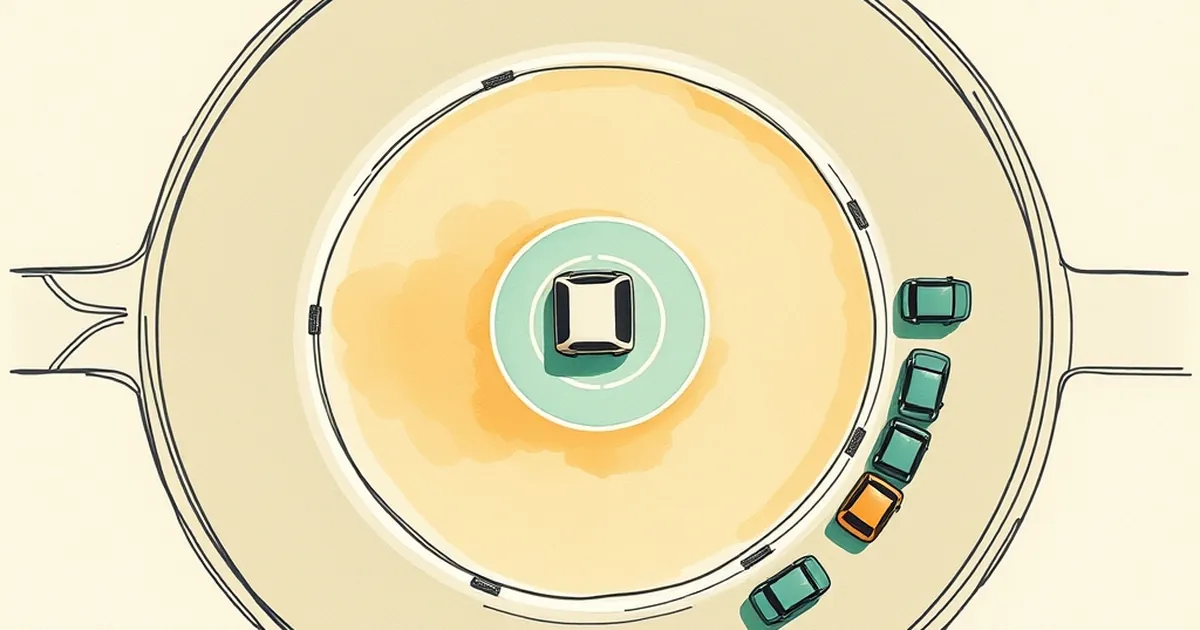
When a driver waits at a busy roundabout entry in Poland, the decision to go is made in under two seconds — often in well under one. A recent observational study suggests that decision gets measurably faster, by roughly 0.4 seconds, when the waiting driver knows other drivers are watching. That number is small enough to sound trivial and large enough to matter: at a typical entry speed of 30 km/h, 0.4 seconds is about 3.3 metres of travel — the difference between a clean merge and a conversation with an insurance adjuster.
The queue is not a passive audience
Polish roundabout design has changed enormously in fifteen years. The older two-lane circulating carriageways with tangential entries have given way, in many cities, to turbo roundabouts and single-lane compact designs with tighter entry deflection. The engineering logic is straightforward: lower entry speeds, clearer priority, fewer conflict points. What the engineering manuals model less carefully is the driver.
A driver at the entry line is performing a gap-acceptance task. The classic model, dating back to gap-acceptance studies on unsignalised intersections in the 1970s and refined continuously since, treats the driver as estimating the time to arrival of the next circulating vehicle and comparing it to a critical threshold. Below the threshold, you wait. Above it, you commit. The threshold is not fixed. It moves with speed, visibility, vehicle type, weather, and — this is the part that gets less attention — with who is behind you.
The 0.4-second figure comes from a Polish observational study that compared entry behaviour at the same roundabout under two conditions: an empty queue behind the subject vehicle, and a queue of three or more vehicles. The measured gap accepted at entry shrank by roughly four-tenths of a second in the queued condition. The drivers were not reckless. They were, in the language of behavioural economics, responding to a cost that had become visible.
What the driver behind you actually changes
Behavioural psychology has a well-developed account of why this happens, and it is not flattering.
The first mechanism is simple social facilitation. The presence of an audience — even an audience of peers performing the same task — reliably increases arousal and speeds up well-practised motor responses. This is one of the oldest findings in experimental psychology, documented in cyclists and typists long before anyone thought to measure it at a roundabout entry. A practised driver making a routine merge is exactly the kind of overlearned task where facilitation shows up.
The second mechanism is cost accounting. Waiting has a private benefit (safety margin) and a social cost (the queue behind you). When the queue is empty, the social cost is zero and the driver can be as conservative as they like. When four cars are stacked behind, the social cost becomes concrete: the driver can see it in the mirror. Kahneman and Tversky's work on loss aversion is relevant here, though in an inverted way. Drivers are not weighing a gain against a loss of equal size; they are weighing a small personal safety margin against a visible, immediate imposition on identifiable other people. Loss aversion predicts that people will take unusual risks to avoid a loss they can see. A queue in the mirror is a very visible loss.
The third mechanism is what operant conditioning researchers call variable-ratio reinforcement. Roundabout entry is a partial-reinforcement schedule: most gaps you accept work out fine, some are tighter than you thought, and the feedback is intermittent and unpredictable. Intermittent reinforcement is famously the schedule that produces the most persistent behaviour and the slowest extinction. A driver who has taken a tight gap a hundred times without incident has been trained, by the road itself, that tight gaps are usually fine. Add a queue and the training effect compounds.
None of this requires the driver to be aware of it. Asked why they went when they did, most drivers will say the gap was there. The gap was there in both conditions. What changed was the price of not taking it.
The engineering countermeasures already in the ground
The interesting thing about roundabout design is that it has been quietly fighting this psychology for two decades, mostly without saying so.
Entry deflection — the curvature built into the entry lane — exists to force lower approach speeds, which raises the actual time available in any given gap. A driver who takes a 0.4-second-shorter gap at 25 km/h is in a very different situation from one who does it at 40 km/h. The deflection is a physical constraint on the psychological effect.
Turbo roundabouts, now common on the approaches to several Polish cities and along major voivodeship roads, go further. By separating lanes with raised markings and spiral geometry, they remove the multi-lane merge ambiguity that produces the worst gap-acceptance behaviour. The driver has one decision instead of three. This reduces the cognitive load that social pressure exploits.
The third countermeasure is less visible: the shift from yield-controlled entries with large approach radii to compact geometries with tight corner radii and short flare lengths. A short entry flare physically limits how many vehicles can queue in the acceleration zone, which caps the size of the audience a driver is performing for.
What the research suggests is that these measures work for reasons the manuals only partly capture. They do not just slow cars down. They reduce the social stakes of the decision.
Where this goes next
The forward-looking question is not whether drivers respond to queues — they demonstrably do — but what happens when the queue stops being made of people.
Connected and autonomous vehicles do not experience social facilitation. They will accept gaps according to their programmed thresholds, and those thresholds will not shrink because a simulated audience is watching. Early mixed-traffic modelling suggests this could produce a period of awkward asymmetry: human drivers taking tighter gaps than their automated neighbours, and automated vehicles, being predictable, becoming the preferred gap to cut into. Polish cities are a long way from that scenario in volume terms, but the first Level 3 systems are already on Polish roads, and the roundabout is one of the hardest cases for them.
The nearer-term opportunity is in data. Roundabout entry behaviour is now measurable at scale through inductive loops, radar, and increasingly through the trajectory data that modern vehicles generate. Cities that collect it can identify which entries produce the largest queue-induced gap compression — the ones where a 0.4-second effect is most dangerous — and target them for geometry changes rather than signage. A warning sign telling drivers to be patient is fighting a reinforcement schedule that has been running for years. A tighter entry radius changes the schedule itself.
The 0.4 seconds is worth taking seriously precisely because it is not a story about reckless drivers. It is a story about ordinary people responding, rationally and mostly unconsciously, to a cost that the road design made visible and the queue made immediate. Design that removes the visibility, or raises the cost of acting on it, is doing more than traffic calming. It is editing the decision before it is made.